
Who we are
Catchgreen is a marine technology and product-development company based in Cape Town, South Africa.
We develop biodegradable ropes, twines, nets and other marine gear for fishing and aquaculture applications. Our work brings together material selection, product design, manufacturing trials, field testing and market development to create practical alternatives to persistent plastic gear.
Products are brought to market through licensed manufacturing and commercial partners, allowing established manufacturers to produce at scale while Catchgreen continues to develop the technology, applications and evidence behind each product.
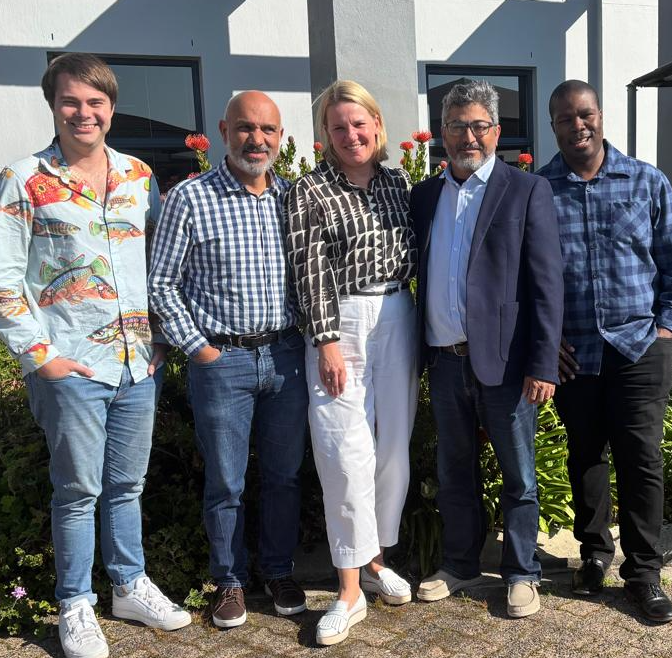
Luke White (product development), Grant January (operations), Emma Algotsson (CEO), Wesley Van Der Heyde (finances), and Loyiso Phantshwa (legal)
We develop biodegradable marine gear for specific working environments and applications. Rather than treating biodegradability as a single material claim, we consider the full product system: polymer chemistry, formulation, filament structure, rope or net construction, required service life, mechanical loading and environmental exposure.
Our work includes:
developing ropes, twines, netting and product components;
adapting products for fishing, aquaculture, seaweed farming, traps, pots and FADs;
coordinating manufacturing and product-development trials;
testing products with marine users in real working environments;
evaluating operational durability and post-loss behaviour;
building partnerships for licensing, commercialisation and wider deployment.
This application-led approach is important because product geometry, yarn diameter, braid structure, mesh configuration and environmental conditions all influence both operational performance and degradation behaviour.
What we do
How we work
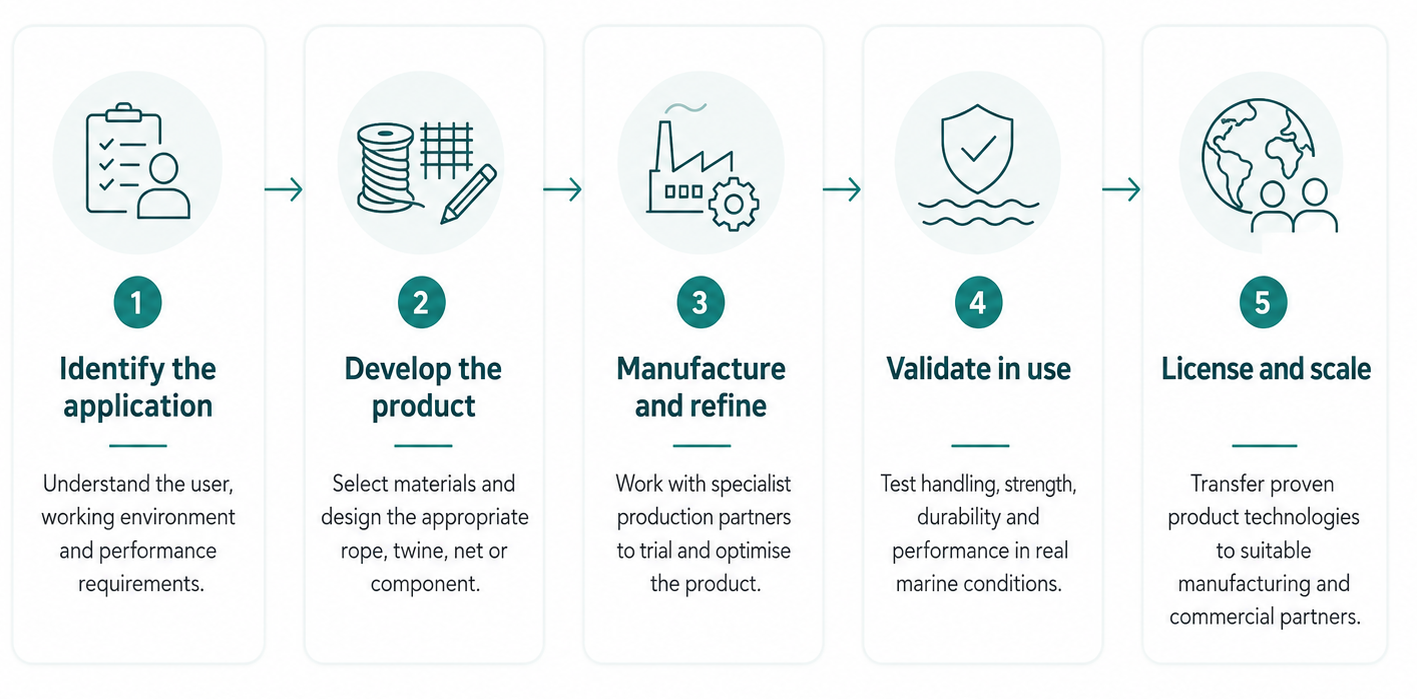
Our approach startes with the application: how the gear will be used, the conditions it must withstand, and the performance required. Materials, product design and manufacturing methods are then selected and refined with specialist production partners.
Products are tested in real marine environments to assess handling, strength, durability and operational performance. Once validated, the technology can be transferred to suitable licensed manufacturing and commercial partners for wider production and market development.
FAQs
-
There is no single degradation timeline for every product or marine environment. The rate depends on the material formulation, product thickness, rope or net construction, temperature, oxygen, UV exposure, water movement, sediment contact and local microbial activity.
Catchgreen products are designed for controlled durability: they must remain strong during their intended service life while progressively losing integrity following prolonged environmental exposure if lost. Thick, load-bearing products will generally change more slowly than thin materials, so each application requires product-specific testing.
-
Catchgreen’s materials are based primarily on biodegradable polyester systems such as polybutylene succinate, or PBS, and related blends.
PBS contains ester bonds that are susceptible to hydrolysis. Exposure to moisture can gradually shorten the polymer chains and reduce molecular weight, making the material increasingly accessible to naturally occurring microorganisms. Under suitable conditions, these shortened chains can be biologically assimilated and progressively converted into carbon dioxide, water, biomass and naturally occurring compounds.
This is different from conventional plastic simply fragmenting into smaller, persistent pieces.
-
Catchgreen products are developed from PBS and related biodegradable polyester blends selected for their balance of processability, mechanical performance and potential for reduced persistence in marine environments.
The precise formulation may differ according to the product and application. Material selection, blend composition, stabilisers, filament structure, rope construction and product thickness are tailored to the required working life and operating conditions.
Not all biodegradable or bio-based polymers behave in the same way in seawater, which is why materials are evaluated for specific marine applications rather than treated as interchangeable.
-
Conventional nets, ropes and lines may retain their strength for many years after being lost, allowing them to continue trapping marine animals.
Biodegradable gear is designed to progressively lose mechanical strength and structural integrity following prolonged environmental exposure. This may shorten the period during which lost gear remains capable of ghost fishing compared with conventional persistent plastics.
The outcome depends on the complete gear design, including the material, yarn diameter, mesh structure, knots, construction and environmental conditions. Biodegradable materials therefore need to be developed and validated for each specific application.
-
PBS-based materials are generally denser than seawater, so many Catchgreen ropes and components are likely to sink rather than remain floating indefinitely.
Sinking alone does not prevent ghost fishing or environmental harm. Lost gear may still interact with seabed habitats, which is why post-loss behaviour, progressive strength loss and biodegradation at the seawater–sediment interface are important areas of evaluation.
-
Compostability and marine biodegradability are different properties and should not be treated as interchangeable.
Some biodegradable materials may be suitable for controlled industrial composting, but this must be demonstrated for the complete finished product under the relevant certification standard. Catchgreen should not claim that all products are industrially compostable unless that product and formulation have been specifically tested and certified.
Where practical, used gear should still be retrieved, collected and managed through an appropriate verified end-of-life route.
-
Conventional plastics can break into progressively smaller particles while remaining chemically persistent. True biodegradation involves changes in polymer chemistry followed by microbial assimilation, rather than physical fragmentation alone.
Available research on PBS fishing materials has identified hydrolysis, reductions in molecular weight and tensile strength, surface erosion and biological conversion under suitable marine conditions. Catchgreen’s materials have also shown changes consistent with early-stage hydrolytic degradation during laboratory and marine exposure evaluation.
Further long-term testing is required to understand the complete degradation pathway of each formulation and finished product in different marine habitats. Catchgreen should therefore avoid making an absolute claim that no temporary fragments can occur at any stage.
-
Catchgreen materials and products have been evaluated through manufacturing trials, laboratory analysis and real-world marine applications.
Testing has included field trials in seaweed farming, modified fishing gear, crab pots and lobster pots. Four PBS-based material grades have also been included in scientific evaluation using methods such as tensile testing, spectroscopy, microscopy, respirometry, chemical analysis and microbial-community assessment.
Early findings include measurable reductions in tensile strength, changes in surface condition and evidence consistent with hydrolytic degradation. Some analytical work remains ongoing, and longer-term field validation is still required.
-
There is currently no internationally harmonised certification standard designed specifically for thick, load-bearing biodegradable fishing and aquaculture gear.
Existing ISO, ASTM and TÜV marine methodologies provide useful biodegradation screening tools, but most were developed primarily for thin films or single-use products under controlled laboratory conditions. They do not fully address ropes, nets and structural components that must remain functional during prolonged marine use.
Scientific discussions increasingly support a three-tier approach combining laboratory testing, controlled environmental or tank studies, and field validation under real marine conditions.
-
Product availability depends on the application, completion of manufacturing trials, field validation and the appointment of suitable licensed manufacturing and commercial partners.
Some rope and twine applications have already undergone extensive field trials, while netting, FAD components, flotation systems and other products remain at different stages of development. Customers and project partners should contact Catchgreen to discuss the availability, trial status and supply pathway for a specific product.
-
No. Biodegradability does not provide a licence to pollute.
Fishing and aquaculture gear should be retrieved and responsibly managed at the end of its working life wherever this is practical. Biodegradable materials are intended to reduce long-term environmental persistence when gear is accidentally lost or cannot be recovered—not to encourage deliberate disposal.
-
Catchgreen works with fisheries, aquaculture producers, research institutions, governments, NGOs and development programmes to define product requirements, coordinate trials and validate performance in real working environments.
Once a product technology has been sufficiently developed and validated, it can be transferred to suitable licensed manufacturing and commercial partners for production and wider deployment.
Catchgreen was established under the Sustainable Manufacturing and Environmental Pollution (SMEP) Programme. The SMEP Programme is funded by the UK International Development and implemented by the UK Foreign, Commonwealth & Development Office (FCDO) in partnership with the United Nations Conference on Trade and Development (UNCTAD).

